
Google Business Profile for Electricians: The Complete Setup and Optimisation Guide (2026)
Published by Electricians Digital — SEO for electricians across Scotland and the UK
Your Google Business Profile is not just a listing. For most electrical contractors, it is the single most important piece of digital infrastructure they have — more important, in the short term, than their website. It is what puts you in the Map Pack. It is what shows your star rating and review count to every person who searches for an electrician in your area. It is the first thing most customers see before they ever visit your website or pick up the phone.
Despite this, most electrician GBP profiles are half-finished. The wrong categories. No service descriptions. Fifty generic photos from setup three years ago and nothing since. No posts. Q&A questions from prospective customers that have been sitting unanswered for months. These are not small issues — each one is a direct ranking disadvantage compared to a competitor who has done the work properly.
This guide covers every element of setting up and maintaining a GBP profile for an electrical contractor in 2026, in the order you should tackle them, with the specific choices that produce rankings rather than just a completed profile.
What is a Google Business Profile and why does it matter more than a website for local search?
A Google Business Profile (GBP) — formerly Google My Business — is your free business listing on Google. It controls how your business appears in Google Maps, in the Map Pack at the top of local search results, and in the knowledge panel that appears when someone searches directly for your business name.
For local searches — “electrician Aberdeen”, “EICR near me”, “consumer unit replacement Peterhead” — the Map Pack appears above all organic website results. The three businesses in that Pack are selected almost entirely based on GBP signals. Your website matters for organic results below the Pack, but it has almost no direct influence on whether you appear in the Pack itself.
This makes your GBP the highest-priority piece of local SEO infrastructure for any electrical contractor. A business with a well-optimised GBP and a mediocre website will outperform a business with a beautiful website and an incomplete GBP in Map Pack results — every time.
According to research cited in the 2026 local search ranking data, GBP signals make up approximately 32% of the total local pack ranking weight. Review signals add another 15–20%. That means half of what determines your Map Pack position is driven by your GBP and the reviews on it — not your website, not your backlinks, not anything else.

How do you claim or create a Google Business Profile for an electrical business?
Before doing anything else, search Google Maps for your business name. If a listing already exists — which is common for established businesses — you need to claim it rather than create a new one. Creating a duplicate listing for an existing business is a suspension risk.
To claim an existing listing: search for your business on Google Maps, click on the listing, and look for the “Own this business?” link. Follow the verification steps from there.
To create a new listing: go to business.google.com and follow the setup flow. You will be asked for:
-
Your business name — exact trading name, no added keywords
-
Your business category — select “Electrician” as primary
-
Whether you serve customers at your location or visit them — for mobile electrical contractors, select “I deliver goods and services to my customers” and hide your address from public view
-
Your service area — the towns and areas you genuinely cover
-
Your contact details — phone number and website URL
After creating the profile, Google will ask you to verify it. In 2026, video verification has become the standard method for most new listings in the UK, particularly for home service businesses. The video must be a single, unedited continuous recording made directly through the GBP interface — you cannot upload a pre-recorded video. It should show branded equipment, tools, or a vehicle alongside some form of business documentation confirming the business name. Keep it simple and clear.
What is the most important setting on a Google Business Profile?
Your primary category. Nothing else comes close.
The primary category is the single most important ranking factor on your entire GBP, and according to Whitespark’s Local Search Ranking Factors 2026, it is also the most important factor in the entire local pack ranking algorithm — above reviews, above proximity, above everything else. Get this wrong and no amount of work on anything else will fully compensate.
For electrical contractors, the correct primary category is “Electrician”. Not “Electrical installation service”. Not “Electrical engineer”. Not “Electrical repair service”. “Electrician” is the category that captures the highest search volume for the broadest range of electrical service searches across the UK.
The primary category tells Google which searches your listing is most relevant for. Change it to something narrower and you immediately become less relevant for most of your potential customers’ searches. There is almost no scenario where an electrical contractor should use anything other than “Electrician” as their primary category.
Secondary categories are different. These add relevance for additional search types without replacing your primary. They should be added carefully, one at a time, each backed by a matching service offering and a corresponding page on your website. Here is how to think about category selection:
| Category | Type | When to add it |
|---|---|---|
| Electrician | Primary — always | This is the correct primary category for virtually every electrical contractor in the UK. It is the highest-volume, most-searched category and should never be replaced with a narrower variant as primary. |
| Electrical installation service | Secondary | Add once your profile is established. Reinforces your relevance for installation-specific searches — consumer units, rewires, new builds. |
| Solar energy contractor | Secondary — when ready | Add when you are actively offering solar PV installation and have a dedicated solar page on your website. Category and website content must align. |
| EV charging station | Secondary — when ready | Add when EV charger installation is a live service with a dedicated website page. Particularly valuable given the growth in OZEV-funded installations. |
| Fire alarm supplier | Secondary — when ready | Add when fire detection installation is a current service offering. Useful for commercial and landlord-focused work. |
| Home automation company | Secondary — when ready | Add when you are actively installing smart home systems, smart switches, or home automation wiring. |
| Security system installer | Secondary — when ready | Add when security lighting, CCTV wiring, or alarm systems are part of your regular service offering. |
| Building inspector | Secondary — when ready | Relevant for businesses where EICR and electrical inspection work is a significant part of the business — particularly for landlord and commercial markets. |
One critical rule on secondary categories: add them gradually. Adding multiple secondary categories in a short window is one of the most common causes of GBP suppression and suspension for electrical contractors. Add one, wait at least a week, monitor your profile, then add the next. If your profile was recently suspended or suppressed, wait 3–4 weeks between any changes before touching categories again.
How should an electrician write their GBP business description?
The business description is 750 characters — roughly 100 to 120 words — of space to tell Google and prospective customers who you are, what you do, and why they should trust you. Most electricians either leave it blank or fill it with a vague paragraph that mentions nothing specific.
A well-written GBP description for an electrical contractor covers:
-
Business identity and location. “Faithful Spark Electricians is a NICEIC Approved electrical contractor based in Peterhead, serving Aberdeen and Aberdeenshire.” This establishes who you are and where you operate in the first sentence.
-
Primary services. Mention the services you most want to rank for: EICR certificates, consumer unit replacement, EV charger installation, solar PV, rewiring. Do not list everything — focus on the work you want more of.
-
Key credentials. “NICEIC Approved Contractor, BS 7671 Amendment 4 compliant, OZEV approved EV charger installer.” These are the accreditations customers search for and Google treats as authority signals.
-
Trust indicators. Review count, trading history, or a specific differentiator that is genuinely true: “100+ five-star reviews”, “18 months to £400k turnover”, “same-day certificates available”.
-
No keyword stuffing. Write it as you would describe your business to a new customer in person. Natural language that happens to include relevant terms performs better than a list of keywords that reads like a bot wrote it.
The description is one of the relevance inputs Google reads when deciding which searches to show your profile for. A description that mentions EICR, consumer units, EV chargers, and Aberdeen will help your profile appear in more relevant searches than one that says “we are a local electrical company offering all types of electrical work”.
How do you set up your service area correctly as a mobile electrician?
Most electricians are service-area businesses — they go to the customer rather than having customers come to them. Setting up your service area correctly in GBP is important both for ranking in the right locations and for avoiding a suppressed or suspended profile.
The right approach for a service-area electrician:
-
During setup, select “I deliver goods and services to my customers” and choose to hide your address from public view. This is the correct configuration for a business without a public-facing premises.
-
Do not list a virtual office, mail forwarding address, or serviced office space as your business address. Google explicitly prohibits this and it is one of the most common causes of GBP suspension for trade businesses.
-
List your home address (hidden from public) or a legitimate commercial premises as your registered address. This is the address Google uses for proximity calculations — it determines where on the map your business is centred.
-
Add every town and area you genuinely serve in the service area field. For an Aberdeenshire contractor: Aberdeen, Peterhead, Fraserburgh, Inverurie, Stonehaven, Banchory, Ellon, Huntly, Turriff, Westhill, Portlethen, Newmachar, Kintore. Be thorough but realistic — do not list areas you do not actually cover.
-
Do not inflate your service area beyond your genuine operational reach. Google factors proximity into Map Pack rankings. Claiming to serve Edinburgh from Peterhead does not improve your Edinburgh rankings — it dilutes your relevance close to home.
For contractors based outside a major city — such as Peterhead — who want to rank in that city, the proximity disadvantage is real and unavoidable. The way to extend your effective ranking range into Aberdeen without a physical Aberdeen address is through dedicated Aberdeen location pages on your website, reviews mentioning Aberdeen from genuine Aberdeen customers, and consistent GBP posting about Aberdeen jobs. These signals help but do not fully override proximity — they extend it.
What is the GBP services list and how should electricians use it?
The services list is one of the most underused and most valuable sections of a Google Business Profile. It allows you to list every individual service you offer with a name and a description for each one. Google reads these descriptions as relevance signals — they feed directly into which searches your profile appears for, in the same way that your website’s service pages do.
Most electricians who have filled in the services list at all have done so minimally — a few generic labels with no descriptions. That is a missed opportunity. Here is what effective service entries look like:
-
Service name: “EICR — Electrical Installation Condition Report”
-
Description: “We carry out EICR inspections for domestic and commercial properties across Aberdeen and Aberdeenshire. Certificates issued same day where possible. From £150 inc VAT for a one-bedroom property. NICEIC approved contractor, all testing to BS 7671 Amendment 4.”
That description contains the service name, the location, a price indicator, a turnaround time, the accreditation, and the compliance standard — every signal a prospective customer is looking for, and every keyword Google needs to understand what the service listing is about.
Do the same for every service you offer: consumer unit replacement, rewiring, EV charger installation, solar PV installation, smoke alarm installation, emergency call-out, commercial electrical work. Each one gets its own entry with a description that mentions the service, the area, and any relevant credential or differentiator.
The services list also feeds into Google’s AI-generated summaries of your profile — the brief descriptions that appear in the Maps interface and in AI search results. A profile with detailed service descriptions produces more accurate and more favourable AI summaries than one with bare service names.
What is the complete GBP setup checklist for electricians?
Here is every element of a GBP profile, the priority level for each, and what fully completed looks like. Use this as your audit against your current profile:
| Profile element | Priority | What complete looks like |
|---|---|---|
| Business name | Critical | Exact legal or trading name. No keyword additions — “Faithful Spark Electricians” not “Faithful Spark Electricians NICEIC Aberdeen”. Keyword stuffing in the business name is a suspension risk. |
| Primary category | Critical | “Electrician” — always. This is the single most important ranking factor on the entire profile. Do not change it without understanding the full impact. |
| Phone number | Critical | One primary number only — the same number used on your website and every directory. Must match exactly across all platforms for NAP consistency. |
| Website URL | Critical | Link directly to your homepage or the most relevant landing page. Ensure the linked page loads quickly and is mobile-optimised. |
| Business description | Critical | Up to 750 characters. Mention your primary services, your service area, your key credentials (NICEIC Approved Contractor, BS 7671 Amendment 4 compliant), and your trading history. Written naturally — not a keyword list. |
| Service area | Critical | List every town and area you genuinely serve. For Aberdeenshire contractors: Aberdeen, Peterhead, Fraserburgh, Inverurie, Stonehaven, Banchory, Ellon, Huntly, Turriff. Do not inflate beyond your realistic reach. |
| Business hours | Critical | Accurate and kept up to date. Update for public holidays and any temporary changes. Google may display “open now” in search results — incorrect hours lose calls. |
| Services list | High | Every service you offer, individually listed with a description. EICR, consumer unit replacement, rewiring, EV charger installation, solar PV, emergency call-out, smoke alarm installation. Each description should mention the service naturally and include your area. |
| Photos | High | Minimum 20 photos at setup. Mix of completed work (consumer units, EV chargers, solar panels, rewires), team photos, branded vehicle, certificates. Add 2–4 new photos monthly minimum. |
| Secondary categories | Medium — phased | Add one new secondary category per month once core profile is stable. Each category must be backed by a dedicated website page and active service offering. |
| Attributes | Medium | Select all that apply: Licensed, Insured, NICEIC Approved. These appear as instant trust signals under your business name in search results. |
| Q&A section | Medium | Ask and answer your own most common customer questions. “How much does an EICR cost?”, “Are you NICEIC approved?”, “Do you cover Aberdeen?”. Unanswered questions are visible to everyone — get there first. |
| Google Posts | Ongoing | Minimum one post per week. Completed jobs with photos, seasonal service reminders, blog links, accreditation news. Posts drive click-through and feed Google’s AI summary content for your profile. |
What ranking signals does your GBP feed into and how important is each one?
Understanding the hierarchy of GBP ranking signals helps you prioritise where to put your effort. Working on a lower-priority signal when a higher-priority one is broken is one of the most common ways businesses waste time on local SEO:
| # | Ranking signal | Approximate weight | What this means in practice |
|---|---|---|---|
| 1 | Primary GBP category | Highest single factor | Set to “Electrician”. Do not change this unless there is a specific, researched reason. Wrong category = suppressed for all your target searches regardless of everything else. |
| 2 | Proximity to searcher | Very high — not changeable | Your registered address determines your geographic centre of gravity. Reviews, location pages, and service area configuration extend your effective reach but cannot override proximity. |
| 3 | Review signals (count, velocity, quality, responses) | ~15% of ranking weight | The most significant ongoing buildable signal. Count, recency, content quality, and response rate all contribute. This is the signal with the most room for active improvement. |
| 4 | Business name keywords | Moderate | If your genuine business name contains a relevant keyword (e.g. “Aberdeen Electrical Services”) that is a ranking advantage. Do not add keywords to a name that does not naturally contain them — it is a suspension risk. |
| 5 | GBP completeness | Moderate-high | Every incomplete field is a missed signal. Description, services, attributes, Q&A, photos, posts — each one adds to the relevance and prominence signals Google evaluates. |
| 6 | Profile activity (posts, photos, updates) | Moderate | An active profile tells Google the business is trading and engaged. Posts, new photos, and Q&A responses all contribute to the freshness signals Google monitors. Static profiles gradually lose ground to active ones. |
| 7 | Secondary categories | Moderate — compounding | Each relevant secondary category extends the searches you appear for. Add one at a time, backed by a matching website page. Category stuffing with irrelevant entries is counterproductive and risks suspension. |
| 8 | Website signals (linked from GBP) | Moderate | The page your GBP links to must be fast, mobile-friendly, and relevant. Google cross-references GBP service listings against your website pages. A GBP that lists EV charger installation but links to a website with no EV charger page loses signal. |
| 9 | NAP consistency (citations) | Moderate | Name, address, and phone number matching exactly across every external directory. Inconsistencies reduce Google’s confidence in your business data and suppress local rankings. |
How many photos should an electrician have on their GBP and what should they show?
Photos are one of the most commonly neglected sections of a GBP profile. Google’s own data shows that profiles with photos receive approximately 42% more direction requests and 35% more website clicks than profiles without them. For electricians, where the quality of the work is directly visible, photos are your most powerful selling tool before a customer ever calls you.
The minimum at setup is 20 high-quality photos. The ongoing commitment is 2–4 new photos per month minimum. A profile that had 25 photos at launch and has added nothing since is a static profile — and static profiles gradually lose ground to active ones in Google’s activity signals.
Here is how to think about your photo library and what each type contributes:
| Photo type | Ranking / trust value | What to show and why |
|---|---|---|
| Completed consumer unit | Very high | A clean, neatly wired full RCBO board with correct labelling is the single most effective photo an electrician can post. It shows standard of work, correct current practice, and builds immediate trust with anyone comparing quotes. |
| EV charger installation | Very high | EV charger photos reinforce your OZEV-approved status visually and support your EV charger GBP service listing. Include the charger, the supply cable routing, and ideally the car connected if the customer agrees. |
| Solar PV installation | High | Array on roof plus inverter and battery storage unit if applicable. Shows both the scale of the work and the quality of the install. Geo-tagging the photo with the installation location adds an extra local signal. |
| EICR / testing in progress | High | A photo of the MFT (multifunction tester) connected during testing, or the completed certificate on-site, signals that this is a real, active inspection business rather than a one-person outfit doing the odd test. |
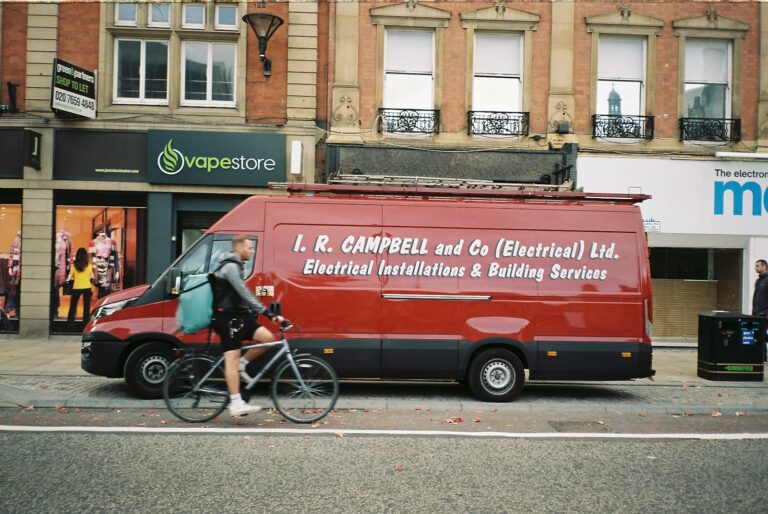
| Branded vehicle | High | A clean, clearly branded van is one of the most effective trust signals available. Customers who see a professional-looking vehicle are significantly more likely to click through and call. |
| Team / engineer photos | Medium-high | A professional photo of the engineer(s) in clean, branded workwear builds personal trust. People buy from people they feel comfortable with. A face on the profile reduces the anonymity that stops some customers calling. |
| Certificates and accreditations | Medium | NICEIC certificate, OZEV approval letter, City & Guilds qualifications. These photos serve as E-E-A-T signals — visual proof that the credentials listed in your profile and website are genuine. |
| Before and after | High | Before and after shots of a consumer unit replacement — old fuse board versus new full RCBO board — are the most compelling work evidence available. They show the problem, the solution, and the quality of the result in two images. |
Practical photo guidance: use good natural light, shoot in landscape orientation, aim for 1200px wide or higher, name your files descriptively before uploading (“rcbo-consumer-unit-installation-aberdeen.jpg” rather than “IMG_0847.jpg”). Do not use stock photos — Google can detect them and they undermine the authenticity signals that genuine work photos provide.
Should electricians geo-tag their GBP photos and does it affect rankings?
Yes — geo-tagging photos before uploading them to your GBP adds location data to the image file that Google can read. When you upload a photo of a consumer unit installation in Aberdeen with geo-tag data embedded, Google knows that installation happened in Aberdeen. This reinforces your local relevance for Aberdeen searches in a way that an untagged photo does not.
How to geo-tag photos before uploading:
-
On desktop: use a free tool like GeoImgr or Geotag Photos to embed GPS coordinates into the image file before uploading. Enter the coordinates of the job location (not your home address).
-
On iOS: ensure Location Services are enabled for your camera app. Photos taken with location services on are automatically geo-tagged at the point of capture.
-
On Android: the same — location data is embedded automatically when location access is granted to the camera. Check your camera settings to confirm this is enabled.
For jobs across Aberdeenshire, this means photos taken on-site carry the location of the job itself, rather than your home address. Over time, a photo library with geo-tags across Aberdeen, Peterhead, Inverurie, and Stonehaven tells Google that this is a genuinely active business operating across the whole of that area.
What should electricians post on their Google Business Profile and how often?
Google Posts are the publishing tool built into your GBP. They appear on your profile in search results and in Google Maps. According to 2026 research, posts do not directly move your Map Pack position on their own — but they do drive click-through from your profile, feed Google’s AI summary content for your listing, and signal active profile management, which contributes to your overall prominence score.
The recommended posting frequency is at least once per week. Consistency matters more than volume — a profile that posts every week year-round outperforms one that posts 10 times in January and then nothing until April.
Posts expire from the visible section of your profile after seven days but remain archived. This is why weekly posting matters — you want there to always be a current post visible on your profile when a customer finds it. A profile with the most recent post dated four months ago looks abandoned.
Here are the post types that work for electricians and why each one earns its place:
| Post type | Example content | Why it works |
|---|---|---|
| Completed job | “Just finished a full RCBO consumer unit replacement in Aberdeen. Old fuse board removed, new RCBO board installed to BS 7671 Amendment 4. Certificate issued same day.” | Shows active trading, reinforces service and location keywords, provides genuine content for Google’s AI summary generator. Photo of the finished board makes it significantly more effective. |
| Seasonal reminder | “Winter is the busiest time for electrical faults in older Aberdeen properties. If your RCD has been tripping repeatedly, that is a sign it needs attention — not just a reset. Call us before it becomes an emergency.” | Relevant, timely content that Google treats as active profile management. Connects to a real customer concern without being promotional in a way that feels forced. |
| Accreditation / news | “We’re now an approved Ohme EV charger installer, adding to our OZEV approval. If you’re looking for a qualified EV charger installation in Aberdeenshire, get in touch.” | Builds E-E-A-T signals, announces new service capability, creates a natural keyword mention for EV charger searches. Links well to your EV charger service page. |
| Blog post link | “How many Google reviews do electricians actually need to rank in the Map Pack? We broke down the data — the answer might surprise you. Link in profile.” | Drives website traffic from GBP. Creates a connection between your GBP activity and your website content. Helps Google understand the relationship between your profile and your site. |
| Customer result | “A landlord in Peterhead contacted us after their EICR came back with a C2 observation on the consumer unit. We replaced the board, re-tested, and issued a clear certificate within 48 hours.” | Tells a real customer story that matches a common search scenario — landlords looking for EICR remedial work. Mentions location and service type naturally without keyword stuffing. |
| Safety tip | “If your smoke alarms are more than 10 years old, they should be replaced. We install AICO interlinked smoke and heat alarms across Aberdeenshire — one visit covers the whole property.” | Useful to the reader, positions you as a knowledgeable professional rather than just someone who wants to sell a job. Mentions a specific product and service area. |
Keep posts between 150 and 300 characters for the main body — that is the length that reads well in the profile panel without being cut off. Always include a photo where possible. Real photos of real jobs consistently outperform text-only posts in click-through and engagement.
How should electricians handle the GBP Q&A section?
The Q&A section is one of the most overlooked features of a GBP profile — and one of the most consequential when it goes wrong. Anyone can post a question on your GBP Q&A, and anyone can answer it. If you are not monitoring and answering your own questions, a competitor, a disgruntled customer, or a well-meaning but inaccurate member of the public could be providing the answers prospective customers see.
The correct approach is to ask and answer your own most common questions before anyone else does. This gives you complete control over the information on your profile and positions your listing as genuinely helpful rather than just a basic business card.
Questions worth seeding and answering for an electrical contractor:
-
“Are you NICEIC approved?” — Yes. Faithful Spark Electricians is a NICEIC Approved Contractor, registration number [number]. You can verify this on the NICEIC website.
-
“How much does an EICR cost?” — EICR certificates start from £150 inc VAT for a one-bedroom property. Prices vary by property size — contact us for a specific quote.
-
“Do you cover [town]?” — We cover Aberdeen, Peterhead, Fraserburgh, Inverurie, Stonehaven, and most of Aberdeenshire. Contact us to confirm coverage for your area.
-
“Can you do same-day electrical work?” — For non-emergency jobs we typically book within a few days. For genuine emergencies we aim to respond as quickly as possible — call us directly on 07304 027013.
-
“Are your prices VAT inclusive?” — All quoted prices include VAT unless stated otherwise. We always confirm total costs before starting any work.
Check the Q&A section weekly. Set up Google Alerts for your business name so you are notified when new activity appears on your profile. Unanswered questions with inaccurate answers from third parties are among the easiest ranking and trust problems to fix — and the most damaging when they are ignored.
How do Google reviews connect to your GBP ranking?
Reviews are the most important ongoing signal on your GBP and the one you have the most direct control over. They account for approximately 15–20% of your total Map Pack ranking weight according to 2026 local search research.
The key review signals Google evaluates:
-
Total count: businesses with 50 or more reviews are 266% more likely to appear in the Local Pack than those with fewer than 10 (BrightLocal 2026).
-
Velocity: a business collecting 7 reviews per month consistently will outrank one with a higher total count but stale reviews. Google weights recency heavily.
-
Star rating: target 4.6 or above. Below 4.0 triggers a visibility penalty. Above 4.6 contributes a credibility multiplier.
-
Review content: reviews that mention service types (EICR, consumer unit, EV charger) and locations (Aberdeen, Peterhead) add keyword relevance signals to your GBP.
-
Response rate: businesses with 90%+ owner response rates consistently outrank those with comparable counts but minimal replies (Yext 2026).
The correct process for every completed job: ask immediately after finishing the work, send your GBP review link directly via WhatsApp, follow up once within 48 hours if no review has appeared, and respond to every review — positive and negative — within 24 hours.
For a complete breakdown of review strategy, thresholds, and velocity targets by market size, see our companion blog: “How Many Google Reviews Do You Actually Need to Rank in the Map Pack?”
What are GBP attributes and which ones should electricians use?
Attributes are the small tags that appear under your business name in search results — things like “Licensed”, “Insured”, “Women-owned”, “LGBTQ+ friendly”. They appear as quick visual trust signals before a customer even reads your description or clicks through to your profile.
For electrical contractors, the attributes worth enabling:
-
Licensed: marks you as holding the relevant qualifications and registration — critical for customers who know they should be checking this.
-
Insured: signals that you carry public liability insurance, which is a basic requirement that not all customers know to ask about.
-
Any language attributes that apply if you serve non-English-speaking customers in your area.
Attributes are found in your GBP dashboard under “Edit profile” then “More”. Not all attributes are available for every business category — Google determines which are applicable based on your primary category. Enable every attribute that is genuinely true for your business. Do not enable attributes that do not apply — inaccurate attributes are a minor spam signal.
How does your GBP connect to your website and why does the link matter?
The website URL you add to your GBP creates a direct connection in Google’s index between your profile and your website. Google cross-references your GBP service listings against your website pages to verify consistency. If your GBP lists EV charger installation as a service but your website has no EV charger page, Google sees an inconsistency — your GBP claims expertise that your website does not substantiate.
This connection works in both directions. A GBP with detailed service listings, reinforced by matching website pages with substantive content, produces a compounding signal that is stronger than either element alone. The GBP tells Google your services and area. The website substantiates those claims with detailed, authoritative content. Together, they present a coherent, credible picture of a real business with genuine expertise.
Practical requirements for the GBP-website link:
-
The URL you add must be the correct, live URL for your website. Not a redirect, not a social media profile, not a third-party directory page.
-
The page it links to — typically your homepage — must load quickly on mobile. A slow homepage damages the signal of the link regardless of its other qualities.
-
The linked page must contain your business name, phone number, and service area — the same NAP information on your GBP — to confirm consistency.
-
Every service listed on your GBP should have a corresponding page on your website. If your GBP lists EICR, consumer unit replacement, and EV charger installation, your website should have a dedicated page for each.
What is the GBP Insights dashboard and what should you be monitoring?
The GBP Performance tab (previously called Insights) gives you data on how customers are finding and interacting with your profile. Monitoring this monthly tells you whether your optimisation work is producing results and where the gaps still are.
The metrics worth tracking regularly:
-
Discovery searches vs direct searches: discovery searches are people who found you by searching for a service (“electrician Aberdeen”) rather than your business name. A growing proportion of discovery searches means your GBP is getting found by new customers rather than just people who already know you. This is the metric that reflects actual Map Pack ranking performance.
-
Actions taken: calls, website clicks, and direction requests. These are your actual leads from GBP. Track the total monthly and look for trends. A well-optimised profile should see this number growing over time.
-
Photo views: Google shows how your photo view count compares to similar businesses in your area. If competitors’ photos are being viewed significantly more than yours, your photo library needs refreshing.
-
Search queries: the specific terms people used to find your profile. This tells you what searches are currently driving your GBP visibility — and what searches you are being found for that you might want to build more content around.
Benchmarks for a sole-trader or small electrical business after active optimisation: 100+ profile views per month (300+ within six months of full optimisation), 20+ actions per month (calls plus website clicks plus direction requests), photo views consistently above the local competitor average.
Why do some GBP profiles get suspended and how do you avoid it?
GBP suspension is one of the most disruptive things that can happen to an electrical contractor’s local SEO. A suspended profile disappears from Maps and search results entirely — no Map Pack, no star rating visible, no calls from people searching for your services. Recovering from a suspension can take weeks and is not always successful on the first attempt.
Understanding the most common causes and how to avoid them is significantly easier than recovering from a suspension:
| Cause of suspension | How to identify it | What to do |
|---|---|---|
| Keyword stuffing in the business name field | Your listing name contains words beyond your actual trading name — e.g. “Faithful Spark Electricians NICEIC Aberdeen 24hr” | Remove all keywords from the name field. Revert to your genuine trading name only. Submit reinstatement request with proof of business name. |
| Adding too many categories too quickly | Profile was recently updated with multiple new secondary categories in a short window, followed by suspension or significant ranking drop | Add secondary categories one at a time, spaced at least a week apart. Each must be backed by website content. Wait 3–4 weeks between changes during recovery. |
| Address listed as a virtual office or mail address | The business address is a serviced office, mail forwarding service, or co-working space that is not your genuine operational base | Google does not accept virtual offices. Use your home address (hidden from public) as a service-area business, or a genuine commercial premises. Evidence of legitimate operation is required for reinstatement. |
| Duplicate listings | A second GBP listing exists for the same business — possibly from an old account, a previous address, or a duplicate created in error | Find and request removal of the duplicate through the GBP support tool. Google cannot have two verified listings for the same business at the same address. |
| Sudden spike in reviews | A large number of reviews arrived in a very short window — either legitimate after a campaign or otherwise | Do not attempt to collect reviews in bulk bursts. Space review requests naturally through ongoing job completion. If suspended after a burst, appeal with documentation of genuine customer interactions. |
| Unverified or recently re-verified listing | Profile status shows as “pending verification” or a recent address change triggered re-verification | Complete video verification as required. Record a single continuous take showing branded equipment, tools, or vehicle alongside proof of business address. Submit through the GBP verification interface. |
If your profile does get suspended, the reinstatement process involves: identifying and correcting the policy violation, gathering proof of your legitimate business operation (utility bill, lease, business licence, NICEIC registration), and submitting a reinstatement request through the GBP appeals tool with a clear explanation of what was wrong and what you have fixed.
Keep records of your GBP account access, any changes you make and when, and any communications with Google support. These are useful if an appeal requires follow-up documentation.
How is Google using AI to generate summaries from GBP profiles in 2026?
In 2026, Google Maps and Google Search increasingly display AI-generated summaries of local businesses — short paragraph descriptions that appear above the standard review snippets in the Maps interface and in local panel results. These summaries are generated automatically by Google’s AI based on your profile content, your reviews, your website, and your GBP posts.
Businesses cannot write these summaries themselves. But the inputs that determine what goes into them are directly within your control:
-
Your GBP description: the most direct input into what the AI says about your business. A description that clearly states your services, area, and credentials produces a more accurate summary.
-
Your reviews: the AI reads review content and extracts recurring themes. Reviews that mention EICR, consumer units, and Aberdeen will produce summaries that reference those services and location.
-
Your service descriptions: the more detailed your service entries, the more accurately the AI can describe what you offer.
-
Your GBP posts: regular posts about completed jobs feed fresh, current content into the AI summary system. Thin or outdated profiles receive less favourable AI-generated summaries regardless of their review score.
-
Your website content: Google cross-references your GBP with your website. A website with well-written, detailed service pages produces better AI summaries than a thin or generic one.
The practical implication: keeping every part of your GBP current and detailed — not just set up once and left — is more important in 2026 than it has ever been, because the AI summary is increasingly the first impression a potential customer gets of your business.
How often should an electrician update their Google Business Profile?
The minimum maintenance schedule for a GBP that holds ranking:
-
Weekly: one new Google Post. One new photo if you have job photos from the week (which you should — every completed job is a photo opportunity).
-
After every completed job: review request sent to the customer via WhatsApp with your direct GBP review link.
-
Within 24 hours of any review: respond to every review — positive or negative — with a genuine, specific reply.
-
Monthly: check the Q&A section for new questions. Review your GBP Insights data. Compare your review count and photo count against the top three competitors in your Map Pack for your main search.
-
Seasonally: update business hours for public holidays and any temporary changes to availability. A profile showing incorrect hours on a bank holiday costs you calls.
-
When adding a new service: add the service to your GBP services list, write a post announcing it, and add a secondary category if appropriate — but only one change at a time, spaced at least a week apart.
The businesses that hold Map Pack positions over years are the ones that treat GBP maintenance as an operational habit rather than a one-off project. Twenty minutes per week — one post, one or two photos, review responses — is enough to maintain an active, well-performing profile. Neglecting it for three months undoes months of ranking progress.
What is the difference between GBP for service-area businesses versus premises-based businesses?
Service-area businesses (SABs) are businesses that serve customers at the customer’s location rather than at a fixed premises customers visit. Most electricians are SABs — they go to properties to carry out work rather than having customers come to an office or shop.
The key differences in how GBP treats SABs:
-
SABs hide their address from public view. The address is still registered with Google and used for proximity calculations, but customers do not see it on Maps.
-
SABs define their ranking area through the service area field rather than through a physical pin on the map. This is why populating your service area list with all the towns you genuinely cover is so important — it directly determines where Google considers you relevant.
-
SABs cannot use a virtual office, mail forwarding, or PO box as their registered address. Google requires a genuine physical address. Using a virtual office is one of the most common suspension triggers for trade businesses.
-
SABs have a proximity disadvantage compared to premises-based businesses when the search originates far from the registered address. A Peterhead-registered electrical business will always be less prominent in central Aberdeen searches than an Aberdeen-registered one, everything else being equal.
The proximity disadvantage for SABs operating across a wide area is real but manageable. Location pages on your website, geo-tagged job photos, reviews mentioning specific towns, and GBP posts about work completed in different areas all help extend your effective ranking range beyond your registered address. They do not override proximity entirely — but they produce meaningful improvement for searches in the areas they target.
Does having a physical address in Aberdeen help ranking in Aberdeen?
Yes — meaningfully. For Map Pack searches originating in Aberdeen, a business with a registered Aberdeen address holds a proximity advantage over a business registered in Peterhead, Inverurie, or anywhere outside the city. This is one of the most direct and difficult-to-overcome ranking disadvantages for contractors based outside the areas they most want to rank in.
For businesses that do a significant and regular volume of work in Aberdeen and want to compete for Aberdeen Map Pack positions, a legitimate commercial address in Aberdeen — a genuine office, workshop, or registered business premises, not a virtual office — provides a proximity advantage that no amount of content or review work can fully replicate.
The options for an Aberdeenshire contractor wanting better Aberdeen Map Pack visibility:
-
A legitimate Aberdeen premises: the most effective solution for sustained Aberdeen Map Pack ranking. Even a modest, genuine commercial address in Aberdeen with visible signage provides a proximity advantage that transforms your competitive position for city searches.
-
Location pages and content: a well-built Aberdeen service page on your website, backed by Aberdeen-specific GBP posts and reviews mentioning Aberdeen, extends your organic reach and partially compensates for the proximity gap in Map Pack.
-
Aberdeen-targeted review strategy: reviews from customers specifically in Aberdeen, mentioning Aberdeen in the review text, reinforce your relevance for Aberdeen searches in ways that reviews from Peterhead customers do not.
This is a real structural challenge for rural Aberdeenshire contractors competing for Aberdeen business. It is worth planning around rather than ignoring — understanding the limitation allows you to make an informed decision about whether a physical Aberdeen presence would justify the cost against the ranking and revenue benefit it would produce.
What mistakes do most electricians make with their Google Business Profile?
The most common GBP mistakes that directly cost electrical contractors ranking and enquiries:
-
Setting the primary category to something other than “Electrician”. Some businesses have been advised to use “Electrical installation service” or a similar variant. Unless there is a highly specific research-based reason for this in your market, “Electrician” is the correct primary category.
-
Adding keywords to the business name. “Best Aberdeen Electricians 24hr NICEIC” is a suspension risk and against Google’s guidelines. Your business name field should contain only your genuine trading name.
-
Setting up the profile and never touching it again. A static GBP profile gradually loses ground as active competitors post, add photos, collect reviews, and update their content. GBP is maintenance, not setup.
-
No service descriptions. A list of service names with no descriptions is a missed relevance opportunity. Each description is a chance to include service keywords, location references, and trust signals.
-
Not responding to reviews. Every unanswered review is a missed ranking opportunity and a missed customer impression. Businesses with 90%+ response rates consistently outrank those that do not respond.
-
Uploading stock photos. Stock photos of generic tools or stock electricians undermine the authenticity signals that real job photos provide. Google can detect them. Customers do not trust them.
-
Ignoring the Q&A section. Unanswered questions from prospective customers, or questions answered inaccurately by third parties, damage trust and may contain incorrect information about your business.
-
Listing a virtual office as a business address. One of the most common suspension triggers for trade businesses. Google requires a genuine physical address.
-
Adding multiple secondary categories at once during a profile change. A rapid burst of category changes is a pattern Google associates with manipulation. Add one at a time, spaced at least a week apart.
How long does it take to see results from GBP optimisation?
Research from Llama Rush and other local SEO practitioners puts the typical window at 30 to 60 days for most service businesses to see measurable ranking movement after a complete GBP optimisation. This assumes the optimisation is genuinely complete — not just filling in a few missing fields, but addressing category, description, services, photos, posts, and any NAP inconsistencies across directories.
What the timeline typically looks like:
-
Week 1: complete every field on the profile. Correct any errors. Upload 20+ initial photos. Fix any NAP mismatches between GBP and major directories.
-
Week 2: add all services with full descriptions. Set attributes. Seed the Q&A section with your most common questions and answers. Publish first Google Post.
-
Weeks 3–4: add 2–4 more photos. Publish second post. Continue asking every customer for a review immediately after job completion. Check Insights for baseline data.
-
Month 2: continue weekly posting, ongoing photos, review requests. Add first secondary category if not already done. Check GBP ranking for main search terms in incognito browser.
-
Month 3 and beyond: ranking improvements should be visible for lower-competition searches. Maintain the weekly rhythm. Monitor competitor review velocity and match or exceed it. Continue adding secondary categories one per month.
For competitive city searches in Aberdeen, Edinburgh, or Glasgow, the journey to a consistent top-three Map Pack position may take six to twelve months of sustained effort. The compound nature of GBP signals — reviews building on reviews, posts building profile freshness, photo libraries growing — means the work done in month one is still paying dividends in month twelve.
Want your GBP set up and managed by someone who does this exclusively for electricians?
Setting up a GBP profile properly takes less time than most people expect. Maintaining it correctly over months and years — posting consistently, managing reviews, monitoring performance, adjusting strategy as competitors improve — is where most businesses fall short. The work is not complicated but it requires consistency that is hard to sustain when you are also running the jobs, managing the business, and doing the actual electrical work.
Electricians Digital works exclusively with electrical contractors across Scotland and the UK. We do not take on non-electrical clients. Everything we do — GBP setup, optimisation, review strategy, website content, local SEO — is built around what actually moves the needle for electrical businesses specifically. If you want your GBP set up correctly and maintained properly, get in touch with us at Electricians Digital.
Official resources and further reading
Google Business Profile — claim and manage your listing
Google’s official tips to improve your local ranking
Google Search Console — monitor your website’s search performance
NICEIC Find a Tradesperson — verify your NICEIC listing
Electrical Safety First — electrician directory
OZEV registered EV chargepoint installers — GOV.UK
IET — BS 7671 wiring regulations and Amendment 4
Published by Electricians Digital | electriciansdigital.co.uk | SEO for electricians across Scotland and the UK
References: Whitespark Local Search Ranking Factors 2026 | BrightLocal Local Consumer Review Survey 2026 | Yext Local Business Trends 2026 | Google Business Profile Help documentation | Digital Applied GBP Feature Guide 2026